
Solar panel cleaning and maintenance service
Verde Solaire washes solar panels and services rooftop systems in Delhi, Noida, Greater Noida, Ghaziabad and Varanasi, for plants it installed and for plants installed by others. Cleaning is offered as a single visit or on a schedule, and maintenance as an annual contract that adds a full check of the connections, earthing, inverter and structure. Both are quoted per site after a look at the roof, because the price depends on the number of panels, their height and whether there is water at roof level. Ask for a written site-specific estimate.
The reason to care is the payback calculation. The panels Verde Solaire sells carry 25-year performance warranties on all three panel types, as published in its July 2025 price posts, and a performance warranty is a promise about output. Dust takes some of that output away every dry day. Every calculator on this site already takes 10% off the published generation figure for soiling and season; that is a planning assumption for Delhi NCR, not a measurement of any roof, and the point of a cleaning schedule is to keep the real loss under it.
What takes the output down on a Delhi NCR roof
Four things account for almost every drop in generation that is not the weather.
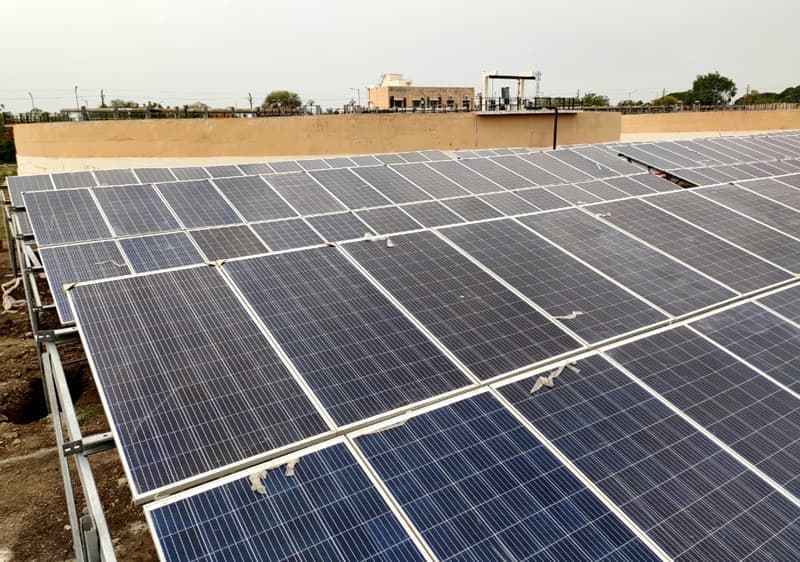
Dust. October and November, when the air is still and the smog settles, and April to June, when the hot wind brings dust storms, are the two stretches when the film on the glass builds fastest. The monsoon rinses it off but leaves streaks where the water dries. The seasonal generation guide goes through the year month by month.
Bird droppings. A dropping shades one cell. That cell resists the current of the whole string and heats up. Wiped within the week, nothing happens; left for a season, it can mark the cell for good.
Shading that grew. The shadow analysis done before installation is a snapshot. A neighbour's tree, a new overhead water tank or a creeper on the parapet can put a shadow across a row that was clear on the day of the survey. The annual visit repeats a version of that analysis.
Loose connections. A DC connector or terminal that has worked loose does not show on the inverter display until it fails. It runs warm, wastes a little power, and is the most common cause of a fault in the first years.
What a cleaning visit does
A cleaning visit is plain water, a soft brush and a squeegee, done early in the morning or after sunset when the glass is cool and the system is making little. No detergent, no scouring pad and no pressure washer, because a manufacturer's care sheet excludes all three and a pressure jet can push water past the frame seals. The team works from the walkway or the terrace floor and never stands on a panel. Dried droppings are soaked and wiped, not scraped. Where the inverter keeps a log, the clear-day reading before and after the wash goes on the job sheet, so you can see what the dust was costing.
The visit also reports what a wash reveals: cracked glass, a chewed cable, a discoloured connector, a nest under the array.
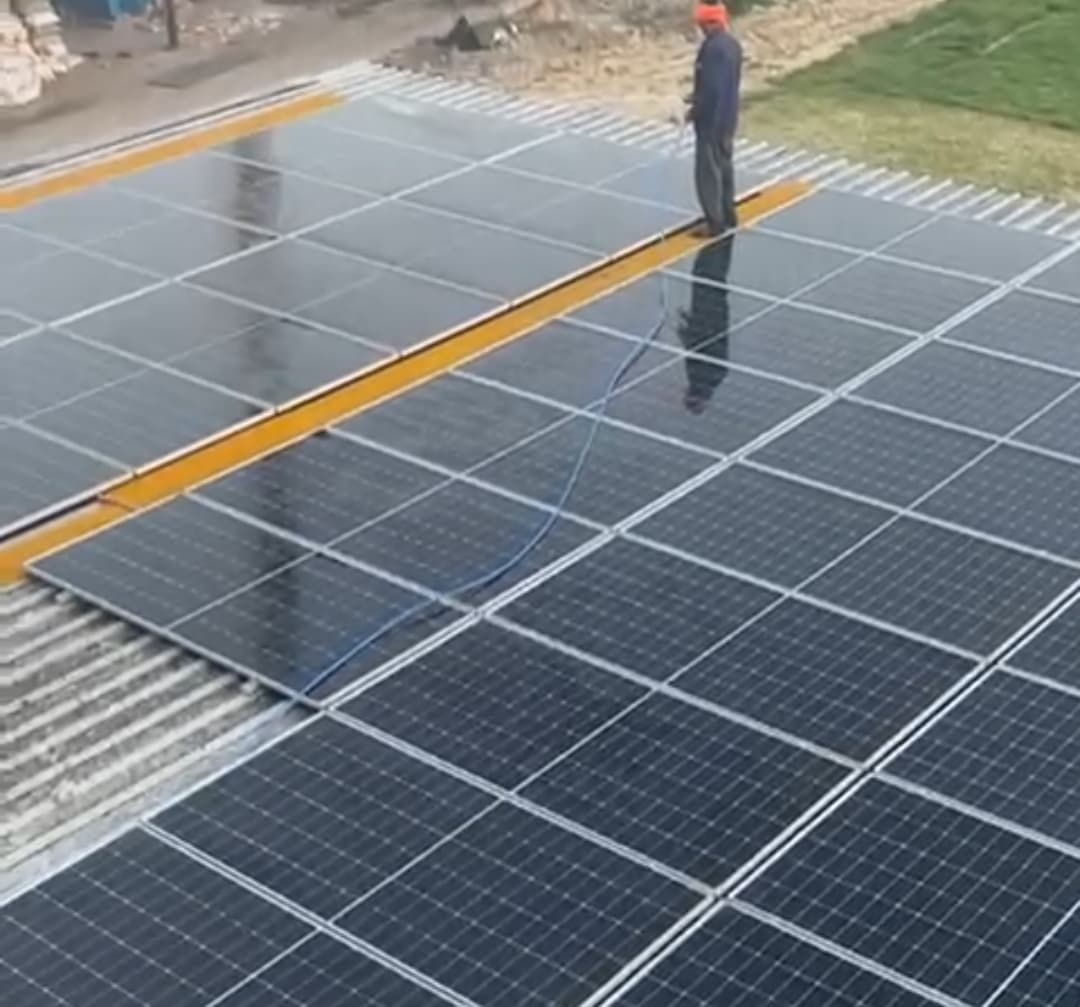
How often is our recommendation, not a published fact: every two to three weeks from October to June, in the week after any dust storm, and once at the end of the monsoon to take the streaks off, with droppings wiped as soon as they appear. A house beside a construction site or a busy road needs the shorter interval. If you can reach every panel from the terrace without climbing, you can do this yourself, and the maintenance guide explains how. Panels on a raised structure, a sloped roof or a factory shed are a job for someone with a harness, which is where the service earns its fee.
What the annual maintenance visit covers
Cleaning keeps the light coming in; the annual visit keeps the electricity going out, and it is the part owners skip because nothing looks wrong. We recommend it in September or October, after the monsoon and before the dust. It covers:
- Connections. A torque check on every DC and AC terminal in the junction boxes and at the inverter, and an inspection of each connector for heat marks, discolouration or water in the box.
- Inverter. The fault log is read and cleared, the vents and fan are cleaned, firmware is updated where the maker has released one, and the year's generation is compared with what a system of that size should have produced. The solar calculator gives the figure to compare against.
- Earthing. Earth continuity of the structure and the inverter is measured, the earth pit is checked, and the lightning arrestor, where fitted, is inspected.
- Structure. Bolts, clamps and module fixings are tightened, rust is treated, and the sealant at every roof penetration is checked so the terrace does not leak in July.
- Cables. Insulation is checked for sun damage and rodent bites; loose ties and conduits are refitted.
- Under the panels. Nests, droppings and leaves are cleared, and any gap birds are using is closed with mesh.
- The meter. The net-meter reading is compared with the inverter's generation log, so a metering problem shows up as a mismatch rather than as a larger bill.
Each visit ends with a short written report. A part or a repair outside the warranty is quoted separately.
What is in writing, and what is not
The two warranty figures Verde Solaire has published are the 25-year performance warranties on all three panel types in its July 2025 price posts and the 10-year warranty on the Havells inverters at its 430 kW factory plant at Dharuhera. Its July 2025 posts also list after-sales support with every installation.
It has not published a workmanship warranty period, the inverter warranty on its home systems, the years of maintenance included with an installation, or a response time for service calls, so this page states none of them. Ask for each in the written quote; the advance checklist and the warranty and after-sales page list the questions to put to any installer.
An annual maintenance contract, or AMC, should name the number of cleaning visits a year, what the annual check covers, what is charged separately, and how a fault call is handled. A contract that does not say how many visits you get is not a contract. The common problems guide describes what goes wrong on systems left without one.
Delhi's zero-upfront scheme
Households the new Delhi scheme covers are reported to get free operation and maintenance for 5 years. For everyone else, maintenance is either included in the installer's quote for a stated number of years or bought separately, and the quote should say which.
Not yet official. Cabinet-approved on 1 September 2026 and reported by the press; the notification and operating rules had not been published when we checked on 16 September 2026. The official Delhi portal still shows the July 2025 figures.
Factory and institutional plants
Large plants need cleaning designed in. Verde Solaire's 430 kW plant at Dharuhera was built with walkways and a module cleaning system, described on its project page. For a factory, school or society roof the contract is scoped with the plant, starting from a free site evaluation and no-obligation proposal. The commercial and industrial page covers the tax and tariff side.
What a well-kept system looks like nine years on
Mr. S. C. Garg installed his system at his home in GK, New Delhi, when the company still traded as Sirius Electric, and wrote that "the solar system has been working continuously without a single day breakdown since 2017". One customer's experience is not a guarantee, and his panels will still have needed washing, but it is what a looked-after system does. On the service side, Mr. Sohail Dhir in New Delhi wrote that "Verde Solaire is very prompt in responding to queries if any".
Questions people ask
Start with a clear plan for your savings
Get a free roof assessment and a written quote for branded equipment. We will also explain the loan, installation, net-metering and subsidy steps.