
Solar panels: mono PERC, TOPCon, bifacial
For a home roof in Delhi NCR the default choice is a mono PERC module from an Indian maker whose model is on the ALMM lists; bifacial panels add output only when mounted on a raised open frame; TOPCon is the newer cell with the highest published efficiency and the highest price. Whichever you choose, a subsidised system must use both the modules and the cells must be made in India, and for net-metered systems commissioned from 1 June 2026 the cells must come from a manufacturer on ALMM List-II.
The rest of this page explains what the three names mean on an NCR roof, what the compliance rules require, which brands Verde Solaire has installed and where, and how to read the datasheet and warranty on the panel a quote names.
The three panel types on an NCR roof
Almost every panel sold for Indian rooftops today is monocrystalline: each cell is cut from a single silicon crystal, which gives the uniform black look and a higher efficiency than the older polycrystalline cells. The three names on a modern quote describe what is done to that cell.
Mono PERC. PERC stands for passivated emitter and rear cell. A reflective layer on the back of the cell sends unabsorbed light back through the silicon for a second pass. It is the mainstream residential module, with the widest choice of Indian makers and models.
Bifacial. The rear of the module is glass or a clear backsheet instead of an opaque one, so the cells also collect light reflected up from the roof surface. The gain depends entirely on what is beneath the panel: a raised frame over a light-coloured roof helps, a panel laid flat on dark RCC gains little.
TOPCon. Tunnel oxide passivated contact is a newer cell design with a thin oxide layer that reduces losses at the contacts. It has a higher rated efficiency and a lower temperature coefficient than PERC, which matters on a roof that spends April to June above 40°C.
Verde Solaire published a comparison of the three in June 2025. The figures below are that post's figures, not measurements of any particular model.
| Panel type | Efficiency as published, June 2025 | Cost as published | Where the post said it fits |
|---|---|---|---|
| Mono (PERC) | 18 to 20% | Moderate | Rooftops with limited space; low light and high heat |
| Bifacial | 19 to 22%, up to 10 to 15% more output if installed right | Slightly higher than mono | Elevated structures, open terraces, reflective floors |
| TOPCon | 21 to 23% | Higher than both | Buyers weighing long-term output over first cost |
The post added that TOPCon was still new in the Indian residential market at the time. A higher efficiency means more watts from the same roof area; it does not by itself mean more units a year, because shading, tilt, dust and heat decide that.
Bifacial only pays with a gap underneath
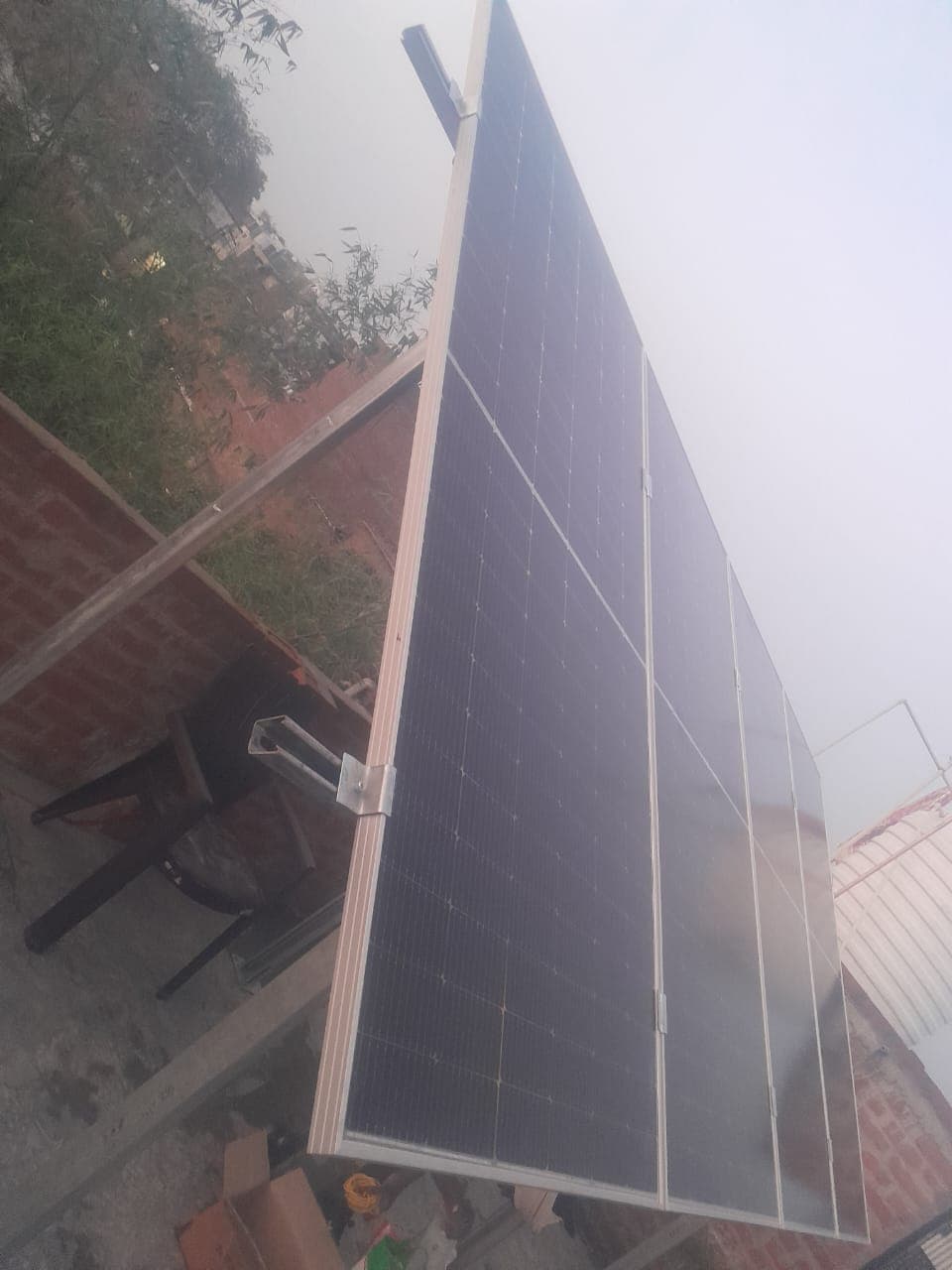
Verde Solaire's 10 kW installation at a home in Greater Kailash, New Delhi, used 530 Wp Adani bifacial modules on a tall open structure, and the owner wrote that he had agreed on mono PERC panels and received bifacial ones at no extra charge. The structure is the point. A bifacial module's rear face needs light, so the array is lifted well clear of the roof with nothing between the modules and the surface. The Greater Kailash project page has the published record.
The company's own June 2025 advice was that bifacial works best where light can reflect behind it, and that on flat RCC rooftops the benefit may be limited. If your quote lists bifacial modules on a low flush-mounted frame, ask what rear-side gain the installer is assuming, and expect the answer to be close to none.
Made in India, DCR and ALMM List-II
Three rules decide whether a panel qualifies for the PM Surya Ghar: Muft Bijli Yojana subsidy, and they are the reason a quote must name the exact model.
- Made in India. The scheme requires that both the modules and the cells must be made in India. The trade shorthand is DCR, the domestic content requirement. A non-DCR module is one assembled from imported cells; it may be a perfectly good panel, but it does not qualify.
- ALMM List-I. The Ministry of New and Renewable Energy keeps an Approved List of Models and Manufacturers. List-I names approved module models by maker and wattage.
- ALMM List-II. From 1 June 2026, net-metered rooftop projects also need cells from a manufacturer on List-II. MNRE opened a one-month window in June 2026 for projects whose modules were on site before that date, and clarified that consumers who give up the subsidy are exempt from List-II until 31 March 2027.
The date that matters is commissioning, not the date you paid the advance. The ALMM List-II explainer sets out the June 2026 clarifications and how to look a model up on the current list. GST on solar modules is 5% (since 22 September 2025, down from 12%), which applies equally to every panel type.
Panels we have installed, and where
Verde Solaire is certified by Vikram Solar as a trusted quality EPC integrator. The table lists the panel makers on the company's published projects, with the page that says so.
| Panel maker | Published project | Module as published |
|---|---|---|
| Adani Solar | Greater Kailash, Delhi, 10 kW | 530 Wp bifacial |
| Adani Solar | Varanasi, 2 kW under PM Surya Ghar | 540 Wp |
| Adani Solar | Jindal Prefab, Dharuhera, 430 kW | Adani modules with Havells inverters |
| Vikram Solar | Marwar Carpets, Panipat, 110 kW | 330 Wp |
| Vikram Solar | Janakpuri, Delhi, 10 kW | Vikram modules with KSolare inverters, on an elevated structure |
| Waaree | Jama Corporation, Kanpur, 200 kW | 335 Wp |
| Emmvee | C-MET Pune, 147 kW | Emmvee modules with a Delta inverter |
| CEL | NISST, Punjab, 20 kW | Central Electronics Limited modules |
The wattage per module has risen from 330 to 335 Wp on the older commercial plants to 530 to 545 Wp on recent homes, so a 3 kW system that once needed nine or ten modules now needs six. The brand on the roof has followed availability and the compliance rules of the day rather than one fixed supplier.
How to read a datasheet
A datasheet is one or two pages, and five lines on it matter for a home in Delhi or Noida.
- Rated power (Wp). Measured under standard test conditions of 1,000 W per square metre at 25°C cell temperature. A roof in May runs far hotter, so real output is lower.
- Temperature coefficient of power. Written as a negative percentage per degree. The smaller the number, the less output is lost as the cell heats. This is the line where TOPCon usually beats PERC.
- Module efficiency. Watts per square metre of panel. Higher means more capacity from a small roof; it does not change the yield of a given kW.
- Dimensions and weight. A 540 Wp module is roughly 2.3 metres by 1.1 metres. Count how many fit with walking space and without shading from the parapet, water tank or a neighbour's wall.
- Certifications. Look for the IEC standards for design qualification and safety, the BIS registration required in India, and the ALMM listing of the exact model name.
The system size calculator turns your monthly units and roof area into a capacity, and the maintenance guide covers what dust does to that output through the year.
Product warranty against performance warranty
Every panel carries two warranties; installers often quote only the longer one.
The product warranty covers the panel as an object: frame, glass, junction box, connectors and workmanship in the factory. It is the one that pays if a module fails outright, and it is typically the shorter of the two.
The performance warranty promises that output will not fall below a stated percentage of the rated wattage after a set number of years, with a permitted degradation each year in between. Verde Solaire's July 2025 price posts state 25-year performance warranties on all three panel types. The calculators on this site assume 0.7% degradation a year for long-run projections, which is an editorial planning figure, not a warranty term.
A warranty is only as good as the manufacturer behind it, one more reason to prefer an established Indian maker on the ALMM list, and a performance claim is made against measured output, so keep the commissioning report and the inverter's generation log from day one. What Verde Solaire itself provides after installation is on the warranty and after-sales page.
What our quote names
A quote that says "DCR panels, 25-year warranty" and stops there cannot be checked. Verde Solaire's written quote, prepared after a free site evaluation and no-obligation proposal, names the module maker, the exact model and its wattage, and the inverter make and model, so that each can be looked up on the ALMM list and the datasheet compared with the figures above. Ask for the cell manufacturer as well, since from 1 June 2026 that is the name that has to be on List-II, and ask for the mounting structure to be described, because it decides whether a bifacial module is worth its premium on your roof.
The same checks apply to any installer. They belong in the same sitting as the vendor-list check and the questions to settle before you pay the advance. Inverters and batteries are covered on the equipment hub.
Questions people ask
Start with a clear plan for your savings
Get a free roof assessment and a written quote for branded equipment. We will also explain the loan, installation, net-metering and subsidy steps.