
Solar inverters: string, hybrid and sizing
Almost every rooftop system in Delhi NCR needs one on-grid string inverter, rated close to the panel capacity, and it comes inside the system price: Verde Solaire's published range for 3 kW, ₹1,99,000 to ₹2,10,000, covers the panels, inverter, mounting, net metering, installation and warranty. A hybrid inverter is only for a home that wants backup during a power cut, and it needs a battery. Whichever it is, the quote names the make and model so that you can check it.
The inverter is the one part of the system with a screen, and the part most likely to be replaced during the plant's life, so it deserves more attention than it usually gets. This page explains the three types, how Verde Solaire sizes them, the makes it has put on roofs, and what to ask before you sign.
What the inverter does
Panels produce direct current. The house and the grid run on alternating current at 50 Hz. The inverter converts one into the other, keeps the panels at the point where they give the most power as light and temperature change through the day, and watches the grid. If the grid's voltage or frequency drifts outside the inverter's limits, or the supply fails, an on-grid inverter disconnects by design, so that nothing is pushed into a line a lineman may be working on. That is why an on-grid system gives no backup in a power cut, which the inverter-battery comparison covers. The inverter also keeps the generation log that every later question about output, export and faults comes back to; the common problems page shows how to read it.
String, hybrid or micro
| String inverter | Hybrid inverter | Micro inverters | |
|---|---|---|---|
| Where it sits | One box on a wall near the meter | One box on a wall, with a battery beside it | A small unit under each panel |
| How the panels are wired | In series, as strings | In series, as strings | Each panel on its own |
| Backup in a power cut | No | Yes, for the circuits wired to the battery | No, unless paired with a separate battery system |
| Shade on one panel | Pulls down its whole string | Pulls down its whole string | Affects that panel only |
| Cost per kW | Lowest | Higher, plus the battery | Highest |
| Service | One unit at ground level | One unit at ground level | Many units on the roof |
| Subsidy | On the solar capacity | On the solar capacity only; nothing on the battery | On the solar capacity |
A plain-language comparison. The PM Surya Ghar subsidy is worked out on the kilowatts of panels in every case.
String inverter. The panels are wired in series into strings, and the strings feed one wall-mounted unit. It is the simplest arrangement, the cheapest per kW and the easiest to service, and it is what nearly every home in Delhi, Noida, Ghaziabad and Varanasi gets. Both of Verde Solaire's published case studies use string inverters: three Delta 70 kW units on the 200 kW Jama Corporation plant in Kanpur and Schneider units on the 110 kW Marwar Carpets plant in Panipat. Its weakness is shade: one shaded panel drags down the string it belongs to, which is why the shadow analysis on the survey comes before any sizing.
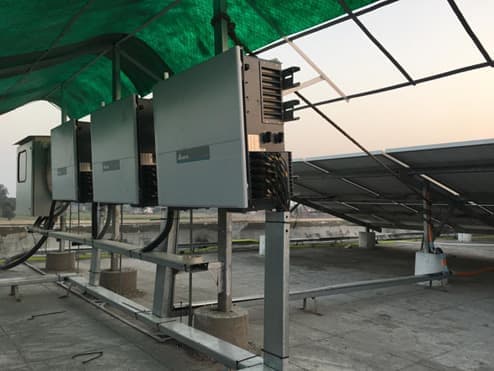
Hybrid inverter. It does everything the string inverter does and also charges and discharges a battery, switching the wired backup circuits over when the grid fails. The inverter costs more, the battery costs more again, and the subsidy does not change, because it is calculated on solar capacity. The inverter-battery page sets out when the extra is worth paying and the off-grid and hybrid page covers the equipment. Batteries themselves are on the solar batteries page.
Micro inverters. A small inverter sits under each panel, so every panel works on its own: shade on one does not touch the rest, and monitoring is per panel. The price is that each kW costs more and there are many more units on the roof, in the sun, in Delhi's summer. None of the projects Verde Solaire has published uses micro inverters. They are quoted when a roof has partial shade that cannot be designed around.
How Verde Solaire sizes the inverter
These are Verde Solaire's working rules, not regulations, and the survey settles the model for your roof.
- AC rating at 80 to 100% of the panel capacity. Panels in Delhi NCR seldom deliver their nameplate output at once, because of heat, dust and the angle of the sun, so an inverter rated a little below the array is fully used for most of the day. The Kanpur plant follows the same logic at scale: 200 kW of modules on three 70 kW inverters. A 3 kW home gets a 3 kW inverter; a 5 kW home gets a 5 kW inverter or one slightly smaller.
- Phase to match the connection. A single-phase connection takes a single-phase inverter; a three-phase connection takes a three-phase inverter, which also spreads the output across the phases. The electricity board approves the inverter's rating in the net-metering application, so it is chosen against the connection on your bill as well as the panels.
- One tracker per roof face. An inverter has one or more maximum power point trackers. A roof with panels facing two directions, or at two tilts, needs an inverter with at least two, so that each face is run at its own best point.
- String length from the inverter's voltage window. The number of 530 to 545 Wp modules in a string is fixed by the inverter's DC input range, not by round numbers, and it is checked for the coldest winter morning and the hottest afternoon.
- A cool, shaded wall. Over-temperature is one of the common fault codes on NCR roofs. The inverter goes on a wall out of the afternoon sun with space for air around it, never in a closed box.
The system size calculator gives the array size from your bills; the inverter follows from it.
Makes Verde Solaire has installed
The company names its equipment on its project pages and its customers name it in their reviews, which is the only basis for this list.
| Make | Where, as published |
|---|---|
| Delta | 200 kW Jama Corporation, Kanpur, three 70 kW string inverters; 147 kW C-MET, Pune |
| Schneider | 110 kW Marwar Carpets, Panipat, string inverters |
| KSolare | 2 kW home in Varanasi under PM Surya Ghar: Muft Bijli Yojana, with Adani 540 Wp panels; 10 kW home in Janakpuri, New Delhi, with Vikram Solar panels |
| Havells | 430 kW Jindal Prefab, Dharuhera, with a 10-year warranty as published in March 2023 |
Verde Solaire is also an authorised solar solutions partner of Luminous, announced on 25 March 2023; the Luminous partner update has what that post said and did not say. Navin Verma, whose 10 kW Janakpuri system is in the table, wrote that he "used Vikram solar panels and KSolare inverters with an elevated module mounting structure" and that the installation "was of very good quality".
There is no single best solar inverter in India, and this page will not name one. The right inverter is one whose maker has service in Delhi NCR, whose model is written on your quote, and whose warranty is in writing with the years and the name of who honours it.
Monitoring
Every current inverter logs its generation, and most send it to a phone app or a web portal through a Wi-Fi or GSM dongle. The log is the record you will need when the export is missing from a bill, when the generation seems low, or when a warranty claim is made, so settle four things before installation: that the monitoring hardware is inside the price, that the app is set up in your name before the installer leaves, that per-string readings are visible where the inverter supports them, and that the log shows generation since the commissioning date. Compare the monthly total with the figure for your city and size on the solar calculator before deciding that anything is wrong.
Warranty, and what to ask
Three warranties sit on one system: the panel manufacturer's performance warranty, the inverter manufacturer's warranty, and the installer's own workmanship warranty. Verde Solaire's July 2025 price posts state 25-year performance warranties on all three panel types; that is the panel term, not the inverter's. The one inverter figure the company has published is the 10-year Havells warranty at Dharuhera. The years on the inverter in your own quote are set out in writing there, and the warranty and after-sales page explains how a claim is handled.
Ask these before you sign, and expect the answers on paper:
- The inverter's make, model and AC rating, next to the panel capacity.
- Single-phase or three-phase, and whether it matches the connection on your bill.
- The number of trackers, if the panels face more than one way.
- Backup during a power cut: yes or no. If yes, the battery make, model and capacity.
- Warranty years, and who you call for a claim.
- Which monitoring app or portal, and who holds the login.
- Where the inverter will be mounted, and whether the DC isolator and surge protection are inside the price.
What an inverter costs
Searches for a 5 kW solar inverter price, or an inverter price on its own, get one straight answer here: Verde Solaire publishes system prices, not component prices. The 5 kW range is ₹3,25,000 to ₹3,50,000 and includes the inverter with everything else. A replacement inverter outside warranty is quoted per site, because the model, the rating and the phase decide it. The pricing pages carry every published range, and the equipment section covers panels and batteries in the same way.
Questions people ask
Start with a clear plan for your savings
Get a free roof assessment and a written quote for branded equipment. We will also explain the loan, installation, net-metering and subsidy steps.